

Utah’s Small Business Economy in 2026: Local Owners Weigh In
Supporting local businesses isn’t just a philosophy for us at First Utah Bank. It’s the reason we exist. Community banks grow when the communities around them grow, which means we pay close attention to how local business owners are actually doing—not just what the economic indicators say.
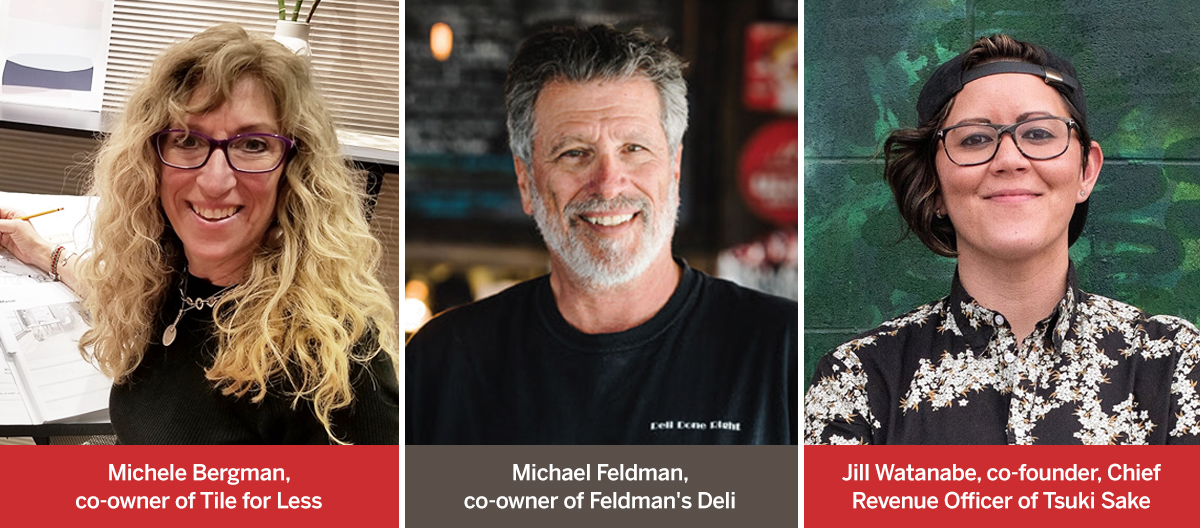
To get a clearer picture of where things stand in 2026, we sat down with three Salt Lake Valley small business owners: Michele Bergman, co-owner of Tile for Less; Michael Feldman, co-owner of Feldman’s Deli; and Jill Watanabe, co-founder, Chief Revenue Officer of Tsuki Sake, a local sake distributor.
Here’s what they told us:
How would you describe the overall economic climate for your business so far in 2026?
Bergman: A healthy increase over the same months last year. We’re off to a robust start relative to last year.
Feldman: I would describe myself as cautiously optimistic. We’re kind of unique being the only Jewish deli — we have a steady base of customers and they seem to be coming out and supporting us. The issue has been rising costs, but I think people have accepted the fact that costs are rising, and so they’re just deciding if they want something, they’ll spend the money.
Watanabe: The categories we sell products for are growing. So on the upside, we’re well positioned for what we are and what the demand has been. Because craft beer is down, wine is down — but we’re well positioned there.
 What is your biggest concern about the economy right now?
Bergman: Tariffs. I’m losing sleep over the possibility of our country no longer having a trade relationship with Spain, because a lot of our specialty tile products are imported directly from Spain.
Feldman: Overall it’s inflation, it’s the uncertainty, it’s the tariffs. The political environment pushes you into a situation where you’re not quite sure how things are going to play out. It’s hard to plan when you don’t know. Locally, a lot of local agriculture is being affected by migrant farm workers who are afraid to show up to work — meat packing plants too. Those are industries that have a lot of migrant workers and they affect our business.
Watanabe: Small businesses are suffering. We usually purchase our bottles in bulk from China, and because of the tariffs, the pricing has gone up exponentially. Aluminum is going up in pricing as well, so if you have to source cans domestically, it helps local steel and aluminum producers monopolize on the market even more. It makes an unfair playing field for other manufacturers.
On the flip side, where do you feel most confident or optimistic?
Bergman: We recently had to fill a position, and compared to the last several years, the quality of the candidates was much, much better. There’s some talent out there that really wasn’t easy to find previously.
Feldman: I think consumers are trying to shop local, and it’s encouraging. We haven’t noticed people switching to cheap alternatives. People decide they’re willing to spend the money to get the quantity and quality that we offer, plus the ambience—the fact that we take care of our customers, we chat with our customers, we offer music and a fun environment for families.
Watanabe: There are a lot of communities growing and forming because of everything going on, people coming together and relying on each other. There are also a lot of people who are supporting locals when they can. Utah in general has always been really inspirational and has surprised me with how people just show up. The local community is really supportive, and that’s always been really amazing, especially when we were a new sake brand in the community.
 Have you noticed any changes in customer behavior or spending habits?
Bergman: A lot of our customers are fixing up homes they currently live in, and it seems like they are staying put. Before, we had more people fixing up their home in order to move or because they just purchased it, or flipping homes. Now, our customers are fixing up homes because they’re going to be in them for longer than they anticipated.
Feldman: People have accepted that costs are rising. If they want something, they’ll spend the money. For things that are not so important, they’re probably pulling back a little bit.
Watanabe: People are just trying to stretch every dollar as far as they can. Quality is not as much of a priority because of that. It can be a little challenging to sell an expensive craft premium bottle of sake when people don’t really know what goes into it.
Have your plans for growth, hiring, or expansion changed because of the current economy?
Bergman: We were able to hire another person, but we haven’t planned on any kind of expansion. I still feel like we’re playing catch-up from the past several years.
Feldman: We’ve just recently hired two people in our kitchen in order to expand our ability to do more specials. After COVID we lost a couple of people in the kitchen and had to step back. One of the things our customers have been asking us is when we’re going to start doing specials again. In order to do that, we need a couple more hands on deck. So we’ve decided to invest in that.
Watanabe: We’ve been doing this for about five years now and we’re constantly asking, “Should we open a brick and mortar?” At this time that seems like a scary venture, just because of the uncertainty with everything, including interest rates and whether people have extra money to spend on things they want. Some of my colleagues who own brick and mortars are suffering more than they did last year because people just don’t have as much money to spend on fun things.
 What adjustments have you made to stay competitive or financially healthy?
Bergman: We increased our spend on our Google AdWords campaign to stay more competitive. A few things that contributed to being financially healthier this year: a little bit more conservative buying, a little less inventory on hand, and a little more special order.
Feldman: You’ve got to have a really sharp pencil in this environment right now, because in Utah there is a glass ceiling—you can’t charge too much before people decide it’s too expensive for them. The good news is that all the restaurants I’ve been to have raised prices—and they’ve raised prices more than we have.
Watanabe: We’re always researching and developing how to stretch each rice grain further. A lot of that is manufacturing modifications. You always have to spend money to make money, and we’ve been doing that for a long time. But there are still successes and room for growth.
What role does shopping locally play in the health of your business and Utah’s economy?
Bergman: Shopping local plays a huge role in Utah’s economy. If you don’t use your small specialty retailers, you’re going to lose them. You won’t be able to go into a shoe store and touch and feel and see the shoes, or walk into a tile store and touch and feel and see the product. If you don’t use it, it’s going to be gone.
Feldman: Staying local allows you to build a closer relationship with your suppliers, and it also gives you more control and consistency. You can sit down directly with somebody local and say, “Hey, I noticed last week that this thing didn’t happen the way it should.” They understand and work with you, and that’s very helpful.
 Looking ahead to the rest of 2026, what are you hoping for?
Bergman: I’m hoping that our foot traffic and our customers’ willingness to buy stays on pace with what we’ve seen in the first two months of the year. And I’m really hoping that world conflicts don’t adversely affect people’s feeling of security and wanting to spend money.
Feldman: I’m hoping that discretionary spending continues, that inflation gets back under control, and that there’s more certainty in everybody’s mind so they feel comfortable doing the things they like to do—instead of becoming fearful and starting to pull back.
Watanabe: We’ve been growing our relationship with Matsumoto City in Nagano Prefecture, Salt Lake City’s sister city in Japan. We sent them samples, met with their Chamber of Commerce. We’re trying to actually create some kind of collaborative sake to tie the two cities together. We’re trying to create bridges between us and Japan — and that’s growing and educating the sake market as a whole.
Do you have a unique take on Utah’s small business economy? Join the conversation via social media and share your thoughts with us: